

Ernst F. Alexanderson
The accomplishments and life of E. F. Alexanderson, 1878-1975
Ernst Alexanderson: "Father of Radio and Television" - Guillermo Marconi.
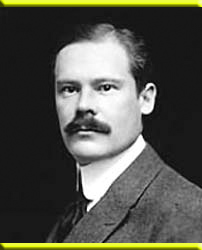
"Alex" was one of the most important engineers of the 20th century. He was a maker of 344 patented inventions from the variable speed AC motor to many devices for telecommunications. As a world-wide respected name in technology he helped guide corporate research to further develop radio and other technologies. His philosophy which helped him innovate was that the most 'fertile soil' for innovations was at the boundary between technological systems. In other words by 'crossing over' inventions from one mainstream use to another area, he could solve problems. He was a control engineer, power utility engineer, radio engineer, electrical engineer, philosopher, and manager.
|
Sections: |
 |
Early Life:
Ernst Fredrik Werner Alexanderson was born January 25, 1878 in Uppsala, Sweden. His father, Professor A.M. Alexanderson was a teacher at the University of Uppsala. Because of an aptitude for mechanics, he entered the Royal Technical University in Stockholm and was graduated as an electrical and mechanical engineer. He attended the Technical University in Berlin, Germany for one year.
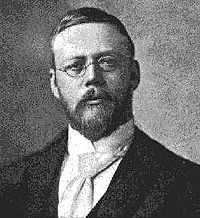
As the son of a professor of languages, Alexanderson as a boy learned English, German, French and Latin in addition to his native Swedish. When an english copy of Alternating Current Phenomena by Charles P. Steinmetz fell into Alexanderson's hands in Berlin he was able to read the volume. It made such an impression on him that he decided to move to America and seek work with Steinmetz.
Steinmetz revolutionized the electrical world by changing the way scientists and engineers thought about electrical circuits. Steinmetz used numbers and algebra to analyze electric circuits, whereas previously engineers used graphical representations of circuits. By 1900 Steinmetz's impact was global and Alexanderson was 'excited' by Steinmetz's work, so much so that in his notebook in 1901 he drew colorful and complex notes and wrote "Steinmetz!" at the top of his page on AC motors.
Move to the United States:
On arrival to the United States Alexanderson visited Edison's operation at Menlo Park. Alexanderson observed that the great days of unrestricted exploration was replaced by an autocratic system. Alexanderson then withdrew his application to work at the Edison Company.
In December 1901 Alexanderson came to Schenectady and met with Dr. Steinmetz and fellow Swede Ernst J. Berg. At the time Alexanderson was in his first job in the US as a draftsman for the C and C Electrical Company in New Jersey. He applied for work both at Westinghouse and General Electric. General Electric accepted his offer immediately and in February 1902 they gave Alexanderson a drafting job on the recommendation of Steinmetz. The next year he took the General Electric Test Engineering Course, he learned from some of the best including William B. Potter who had been a mastermind at Thomson-Houston Company. In 1904, after Test, he became a member of the engineering staff designing generators under the direction of Steinmetz.
The Innovative and Tenacious Alexanderson
Alexanderson's first patent was for a reverse-current relay for protecting against short circuit faults. He worked on the idea in October 1902 and later. His invention saved a lot of money in power systems by removing the need for an instrument line between stations. His second patent for improvement of the AC motor hit a snag when Steinmetz reviewed it and discovered a problem with the design. GE's Patent Department than stopped the motion to patent. Alexanderson then figured out a solution to the problem, and decided not to tell GE, wanting instead to sell it to another company and make more money.
Alexanderson was clear headed and began his career always looking out for himself. This is not a guy who could be taken advantage of easily. Alexanderson was a genius who knew his value. He found the drafting jobs boring, he shopped around for jobs and was frequently trying to get raises. Despite Steinmetz being his 'hero' he did not let on to General Electric that he was desperate to work there. He always negotiated and made his moves carefully. If Alexanderson was not tenacious and confident he would have likely ended up in a non-impactful job, and the world would not be in the same place it is today. His inventions touched on everything from television (which every layman can understand), to improvements in complex apparatus for the AC system which are very important yet seldom understood by the layman.
High Frequency Alternators, revolutionizing telephone and radio:
Many people today are not familiar with the device or why we need such a device. Today we can use vacuum tubes or solid state technology to amplify electric signal, but in the time of Alexanderson those tools were not available. In 1891 John S. Stone of American Bell Telephone came up with the idea of using a high frequency alternator (a rapidly spinning disk) to act as a repeater to amplify signal. He needed to boost telephone signals to cross great distances with copper wire. Stone was thinking about the nexus of AC generator technology and the communication field. Many AC power innovators crossed the lines from telecommunications to power utilities, bringing advances from their experience in the other field.
George Pickard improved Stone's idea in 1902 by coming up with a design to change the permeability of an iron core to do the job of amplification. His design used a number of copper wire coils positioned in various places on and around an AC generator. Alexanderson's work with Fessenden resulted in many great improvements to get the speeds up.
|
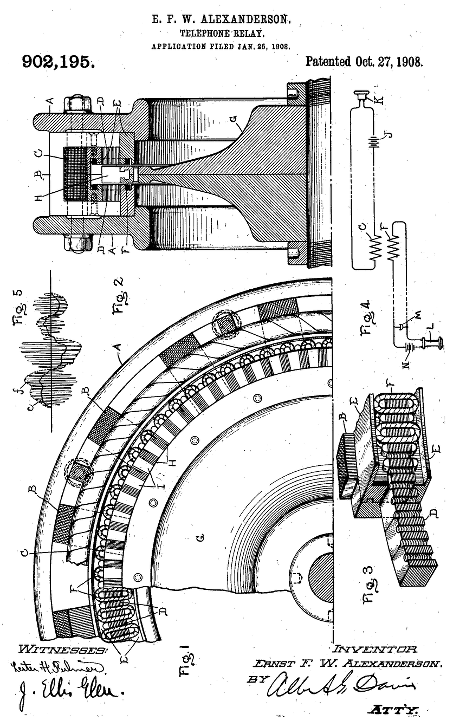
Try spinning any object at 12,000 rotations per second and you will discover the engineering challenges facing Alexanderson! While creating a rotating disk or coils (as in Pickard's invention) seemed simple, it became mechanically and electrically extremely challenging once the speeds increased. Hurtles to high speed rotating machines included elastic deformation of the spinning disk, which changes the electrical properties. Another problem was friction with air, moving an object that fast in the air will generate a lot of heat. The heat negatively effects copper and solder. There was at least one time when these big spinning machines got out of control and Alexanderson and others ran for cover. Fessenden's efforts centered around getting two spinning metal disks, he was stuck on the idea and insisted on pursuing this in the design. At the same time Alexanderson was working for AT&T, allowing him to pursue his own theory that a single disk could produce better results. Alexanderson assisted AT&T with developing high frequency alternators starting in 1907. Both Fessenden and AT&T were pursuing HF alternators and after some time they both discovered that their efforts were in duplication at GE. While Fessenden ended support at GE after some time, the GE team decided to continue work on alternators. By 1908 Alex had created a 100 kHz (20k rpm) alternator, breaking all previous records. His use of laminated rotor teeth (see patent drawing to the right) prevented him from increasing the speed even more, so this problem led him to his great advancement of creating a magnetic amplifier with no moving parts later on. During his work on the alternator Alexanderson advanced the engineering field by coming up with a new empirical formula for air friction loss on a rotating disk. Orders poured in for Alexanderson's new 100 kHz alternator for telegraph and telephone systems. |
|
See our page on amplifiers to learn more about this area of electronics >
Naval uses, war and peace:While today we think of radio and GPS as being a necessary for aircraft and ships, it did not start that way. After a sinking incident in 1909 where wireless successfully summoned nearby ships to help, it became apparent that wireless should be required for ships. The Navy was a large supporter of wireless development, putting up new goals to meet and ordering alternators from General Electric. There were attempts by the German and US Navies to regulate wireless and limit its civilian and commercial development, Fessenden was active politically to oppose forces as he saw his work should benefit society, not just improve war applications.
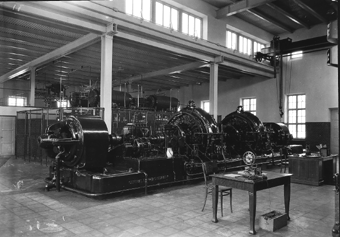
The two Alexanderson alternators at Grimeton, Sweden
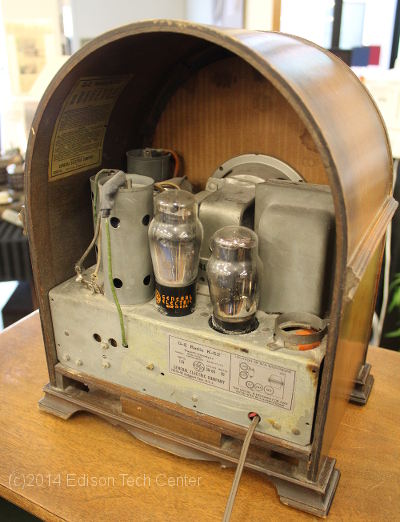
Vacuum tubes accelerated the development of radio. Learn more about vacuum tubes here |
|
From 1919 to 1924 Dr. Alexanderson divided his time between General Electric and RCA, maintaining his residence and laboratory in Schenectady but personally superintending construction of powerful radio stations in Sweden, Poland, England, Hawaii, California and on Long Island. At the opening of a trans-Atlantic station at Grimeton, in his native Sweden, Dr. Alexanderson received the Order of the North Star from the hands of King Gustav V.
 |
|
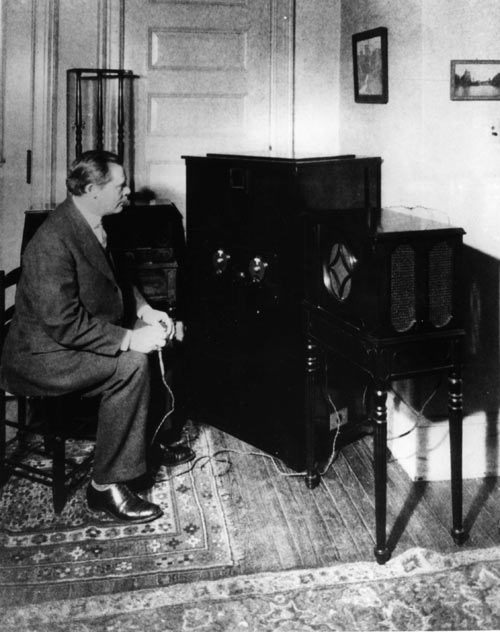
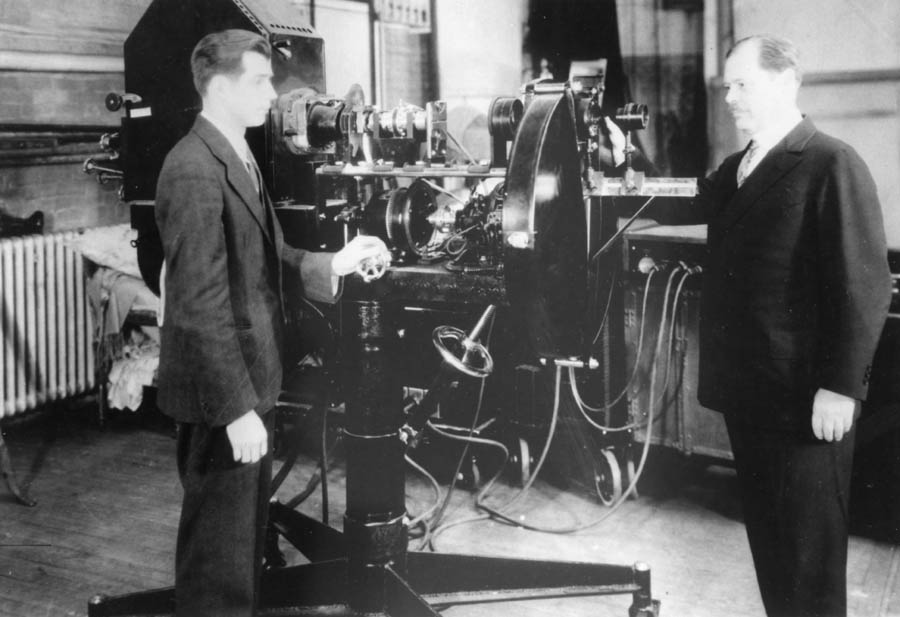
Dr. Alexanderson and his TV projector which was used a Proctors Theater for one of the early public demonstrations of television.
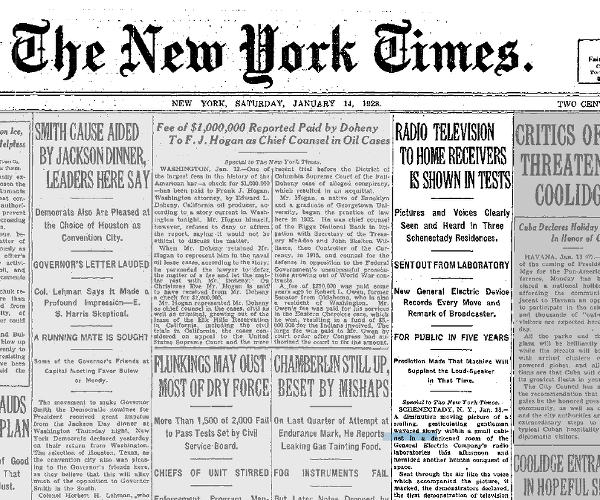
New York Times: January 14, 1928:
"Radio Television To Home Receivers is Shown
in Tests:
Picture and Voices Clearly Seen and Heard in Three
Schenectady Residences"
"For Public in Five Years"
"...the first absolute proof of the possibility of connecting homes throughout the world by sight as
they already been connected by voice."
"some engineers predict [televisions] may be in most of the homes
that now possess loud-speakers."
"Home television was developed by Dr. E.F.W. Alexanderson, consulting
engineer of the Radio Corporation of America and the General Electric Company and
his assistants. For seven or eight years he had worked on the principle of television
but the home sets are the development of comparatively recent months."
After 1930:
With the separation of the General Electric Company and the Radio Corporation of America starting in 1930, Dr. Alexanderson devoted himself to power application of the electronic science such as power transmission with direct current. Alexanderson was not happy about the split of GE and RCA, this would end support for his radio-television research. Despite this he continued his interest in short-wave phenomena and in television.
Alex used his military connections to get funding to continue work on radio/television after the RCA split. He wrote to David Sarnoff many times about continuing to support TV work at GE but in the end he could not get his support.
In addition to his radio achievements, Dr. Alexanderson has produced an ever lengthening list of inventions in the power and control fields. These account for many of his patents obtained over a period of thirty-five years on an average of roughly a new patent every seven weeks.
Philosophy and Recreation:
Alex was more than just a technical guy, he had an interest in the big picture of society. This makes sense of course because he was watching the world change directly as a result of his own inventions. He wrote speeches like "Television and Its Uses in Peace and War" in which he talked about his own blindness in seeing the social significance of TV and where we were headed. He saw the need for 'breathing room' so that an area of technology could mature. For example television requires the loudspeaker for voice reproduction, the CRT for image, radio transmission and camera technologies all to be caught up with one another. Alexanderson wrote to the FCC and GE management about philosophies of how scientists and engineers should react to foster creation. He spoke of the interdependence of a broad range of technologies, and that the GE Research Lab continue to have this integration to drive development. One important trait of engineers he believed was to understand that good engineers use "resourcefulness, skill and courage" and not to worry or focus on success.
In the 1930s he developed a passion for sailing. He was a founding member of the Lake George Yacht Club. He took a trip to the West Indies and owned many boats at Lake George. All of this time his hearing deteriorated and he had to wear a hearing aid.
1940s, 50s and 60s Work:Dr. Alexanderson 'retired' in 1948. He loved his work and had no intention of stopping. He continued to work as a consultant at the GE Research Lab and sailed on other days. In 1949 he married his third wife, having been widowed twice already. The family continued Swedish traditions at holidays. In 1951 Alexanderson became unhappy at the structural changes at GE and separated from the company. See our documentary on Guy Suits to learn more about this period of GE management. Alex was sharp and inventively competitive. When news of the transistor broke he decided to work on solid state at his home lab since he no longer had access to the GE Research Lab. He published his last professional paper in 1952 on the transistor.
In 1955 Alexanderson was granted a patent for the color television receiver. He had begun development of color TV in the 1930s but it wasn't until later that the masses were able to enjoy this technology. He went to Sweden in 1955 to look at a HVDC project which was being developed by Uno Lamn of ASEA. This project was the first major DC link between two AC systems. He worked on uses of semiconductors to replace vacuum tubes at his home lab with his assistant Albert Mittag. His last patent was for an adjustable-speed motor control system using semiconductor parts. Alex passed away in 1975.
Awards:
In 1934 Dr. Alexanderson was elected to the Royal Academy of Science of Sweden, the body which bestows the Nobel prizes in science. Besides the Swedish Order of the North Star, Dr. Alexanderson received the Medal of Honor of the Institute of Radio Engineers (1919), knighthood of the Polish Order of Polonia Restituta (1924), and the John Ericsson medal for outstanding contributions to the field of radio engineering (1928). He was a member and past president of the Institute of Radio Engineers (IRE) and a fellow of the American Institute of Electrical Engineers. He received honorary degrees of Doctor of Science from Union College, Schenectady (1926), and Doctor of Philosophy from the Royal University of Uppsala, Sweden (1938). In 1940 his name was listed on a "Wall of Fame" honoring foreign born citizens who have made notable contributions to American democracy. This was unveiled at the New York World's Fair.
|
|
|
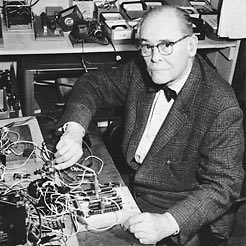
Inventions List:
Here are some of Alexanderson's inventions or areas he improved. 'Improvement' may not sound as important as 'invented', however many times Alexanderson's improvements were almost more important than those who conceptualized the invention. Alexanderson made impractical inventions work better become cost effective.
Naval communication: radiotelephony (improved)
Self-exciting alternator (invented)
Television (improved)
Home television reception (transmission of video and still images over radio) (invented)
Long distance voice radio transmission (invented)
Ship propulsion (turbo-electric generator) (improved)
AC railroad traction motors (single phase) (improved)
Long distance telephone: Magnetic amplifiers (improved)
Vacuum tubes (helped Albert Hull improve them)
Radio altimeter (improved)
DC and AC circuit switches (improved)
AC to DC rectification (improved)
Electronically controlled guns for the navy (improved)
Antenna design (improved)
Drones and weapons guided by television (conceived and developed)
Large screen projection TV (6' wide rear projection 1930)(invented)
Industrial power system improvements (like the amplidyne)(improved)
Railroad signaling technology (invented the all-wave radio receiver)
Magnetic Amplifier to control radio, 1912 (made the first working prototype)
Phase Converter used in electric railways (invented)
Further Reading:
We recommend "Alexanderson, Pioneer in American Electrical Engineering" by James E. Brittain
Hear the voice of Dr. Alexanderson in this video (he is featured in the middle) (YouTube Video):
Books on Alexanderson: "Ernst Fredrik Werner Alexanderson" by Bengt V. Nilsson get it at www.grimetonradio.se
Visit the Edison Tech Center in Schenectady to see our collection of historic books on Alexanderson

Related Topics:
Television |
Microwave Ovens & Magnetrons |
Amplifiers |
All types of Electric Motors |
Radio |

More Stuff |
Article by M.W.
Sources:
Alexanderson, Pioneer in American Electrical Engineering. by James E. Brittain
New York Times
Schenectady Museum
Photos:
Schenectady Historical Society
The Schenectady Museum
Edison Tech Center
If you are a historian and wish to correct facts or publish a commentary or embedded article feel free to contact us.
Photos:: Permission and fees are required for use of photos in printed or internet publications.
Educational Use:: Students and teachers may use photos and videos at school. Graphics and photos must retain the Edison Tech Center watermark or captions and remain unmanipulated except for sizing.
Videos:: DVDs are available for personal/educational use. Republication of any part or whole of any ETC video requires a professional license agreement. Contact us for legal permissions and fees.